Over the past four decades, Motivational Interviewing (MI) has become one of the most highly regarded and evidence-based communication approaches in contemporary mental health and addictions practice. It’s not the coercive kind that tries to shame you into sobriety, but instead a version tailored precisely “to help people get in touch with their reasons and readiness for change. At New Soch Rehab and Psychiatric Center Islamabad, motivational interviewing is an empathic, ethical, client-centered style to guide individuals with substance use disorder or mental illness issues.
The purpose of this study was to illustrate in practice real-life cases of motivational interviewing and the outcomes for patients in routine clinical conditions. Finally, it explains why MI can be so useful in an Addiction treatment center in Islamabad Pakistan, having cultural sensitivity being particularly important along with trust and long-term recovery.
Motivational Interviewing in the Treatment of Addictions
Motivational Interviewing is a goal-oriented and person-centered style of communication in which one uses the guiding method to enhance intrinsic motivation by helping peopleexplore and resolve ambivalence. Rather than confronting or judging the patient, clinicians respond with empathy, reflective listening and open-ended questions.
By the stabdard of MI, addicts in an Addiction treatment centre Islamabad Pakistan come when they are abmiguos, pressurized by family and just scared to stigma. MI meets them at their emotional and psychological level.
Key principles include:
- Expressing empathy
- Supporting self-efficacy
- Rolling with resistance
- Discrepency between present behavior and personal goals.
The Importance of Applied Practice in Rehabilitation Sectors
Theory does not cure addiction. Practical application demonstrates how motivational interviewing shifts clients from denial or ambivalence to acceptance and practice.
At New Soch Rehab and Psychiatric Center Islamabad , the topic of MI is not just a one off discussion. It’s interwoven into evaluations, therapy sessions and aftercare planning. These are the IRL moments that show how small nudges in communication can create significant change.
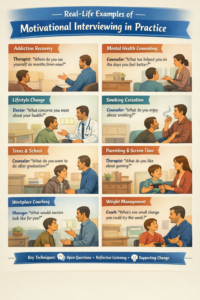
Example 1: Denial in Early Recovery Article discussing denial in the early recovery phase
The Situation
A young adult is referred to treatment after contracting with his family over substance use. He doesn’t see that he does drugs in excess as a bid deal, and is only there willing to rehab because of his parents.
Motivational Interviewing in Action
Rather than argue, the therapist accepts his feelings:
- “It seems that you feel misunderstood and pressured.”
The counselor then poses open-ended ones:
- “What do you like about your current way of life?”
- “Have there been times when drugs or alcohol contributed to pain or lost opportunities?
Outcome
Eventually, the client becomes aware of inconsistencies between how he wants to be and who he is. This kind of self-awareness is usually the first step in seeking treatment at an Addiction rehab clinic in Islamabad Pakistan.
Sample 2: Working with Hopeless Clients Following a Relapse
The Situation
A middle-aged man comes back into treatment after another relapse feeling embarrassed and totally discouraged recovery can be achieved.
Motivational Interviewing in Action
The therapist does not blame and focuses on the strengths:
- “You’ve come back for help, and that demonstrates commitment.”
Reflective listening can help normalize this experience:
- “Relapse has left you feeling discouraged, but it doesn’t negate the progress you’ve made.”
Outcome
MI also supports clients to see relapse within the frame of recovery journey, by enhancing confidence and self-belief. New Soch Rehab and Psychiatric Center Islamabad believes in and practices this treatment approach.
Instance 3: Support and Pressure in the Service of Engagement
The Situation
A client has spotty attendance and lacks motivation for a scheduled therapy approach.
Motivational Interviewing in Action
The counselor does not make the position report mandatory but rather uses it as a tool for examining personal values:
- “What matters most to you at this moment?”
- “What does life look like a year from now if nothing changes?”
Outcome
Often clients start coming more reliably when they link their goals in treatment with aspirations for themselves. This respectful approach builds trust in a Rehabilitation facility of Addiction Islamabad, Pakistan.
Example 4: Dealing With Family Pressure and Societal Expectations
The Situation
Far too many clients arrive at rehab feeling family or societal pressure instead of a personal interest in taking this step.
Motivational Interviewing in Action
The therapist also distinguishes pressure from motivation:
- “What do you want for yourself even if it’s not what anyone else wants?”
Respecting cultural values and individual autonomy, MI provides a platform for open and authentic conversation.
Outcome
Patients feel listened to, not controlled making them more amenable for therapy in New Soch Rehab and Psychiatric Center Islamabad.
Example 5: Reinforcing Commitment Following Aftercare Planning
The Situation
Client feels scared to be sober and out of the residential setting.
Motivational Interviewing in Action
The counselor asks:
- “What tactics have helped you maintain your focus during treatment?”
- “Who in your life can help you in recovery?”
Affirmations reinforce confidence:
“You already have skills that you can use to navigate these challenges.”
Outcome
Patients take ownership and confidence with them when they leave treatment, important to their long-term recovery in any Addiction rehab facility in Islamabad, Pakistan.
Role of Motivational Interviewing in Psycho and Rehab Care
The following are some benefits of the use of motivational interviewing in health-care based rehabilitation settings:
- Builds trust and therapeutic alliance
- Reduces resistance and defensiveness
- Supports ethical, non-coercive care
- Encourages long-term behavior change
- Compatible with evidence-based procedures in mental health
At New Soch Rehab and Psychiatric Center Islamabad, these advantages help create an environment promoting patient-centred recovery.
Integrating Motivational Interviewing Into Healthcare and Beyond: An Introduction to the Ethical Aspects of MI
Ethical communication is particularly important in the health professions, such as addiction and psychiatric care. MI values the patient’s autonomy and does not make non-credible promises or coerce.
This is the philosophy consistent with how an addiction rehab center in Islamabad, Pakistan should be run as; ethically, professionally and considering that each person has a different story to tell.
Frequently Asked Questions (FAQs)
1. What is MI in addiction treatment?
Motivational interviewing is a form of counseling that assists individuals with exploring their own reasons for change as opposed to being instructed what to do.
2. Is motivational interviewing appropriate for the treatment of any kind of addiction?
It is efficiently employed at all levels of addiction when resistance, ambivalence or emotional conflict is present.
3. How Have you watched Nick Stones Why it takes so long to get better?
Based on an enhanced self-efficacy and internal motivation, MI supports individuals in increased active recovery post-primary treatment.
4. It’s used in psychiatric care also?”
Yes, it works in psychiatric settings especially when combined with psychotherapy to promote adherence and insight.
5. Does New Soch Rehab and Psychiatric Center Islamabad use motivational interviewing?
Yes, motivational speak is in the therapeutic repertoire to help patient-centered, ethical care.
Conclusion
Examples from everyday practice illustrate the utility of motivational interviewing in both addiction treatment and psychiatric intervention. By emphasizing empathy, partnership, and self-motivation MI supports people in taking steps toward change that are meaningful to them.
At New Soch Rehab and Psychiatric Center Islamabad, motivational interviewing can encourage inpatients to maintain ethical standards of healthcare even as they grapple with the emotional implications of addiction. To somebody who wants to recuperate at an Addiction rehabilitation center in Islamabad, Pakistan like us, this means a process full of compassion and respect leading to change that will last.